Personality Test: Discover Your 16-Type Profile, Traits, Career Match and Growth Plan
Personality tests can be useful tools for understanding behavioral preferences, communication habits, decision-making patterns, and the ways people approach work and relationships. A well-designed assessment does not need to reduce a person to a single label. Instead, it can provide a structured framework for exploring tendencies and reflecting on how those tendencies appear in everyday situations.
The Checker.Free Personality Test is designed as a comprehensive self-reflection and cognitive profiling tool. It combines a 60-question assessment with four core personality dimensions, a 12-trait radar, personality archetypes, career alignment suggestions, relationship insights, compatibility analysis, and a seven-day cognitive development challenge.
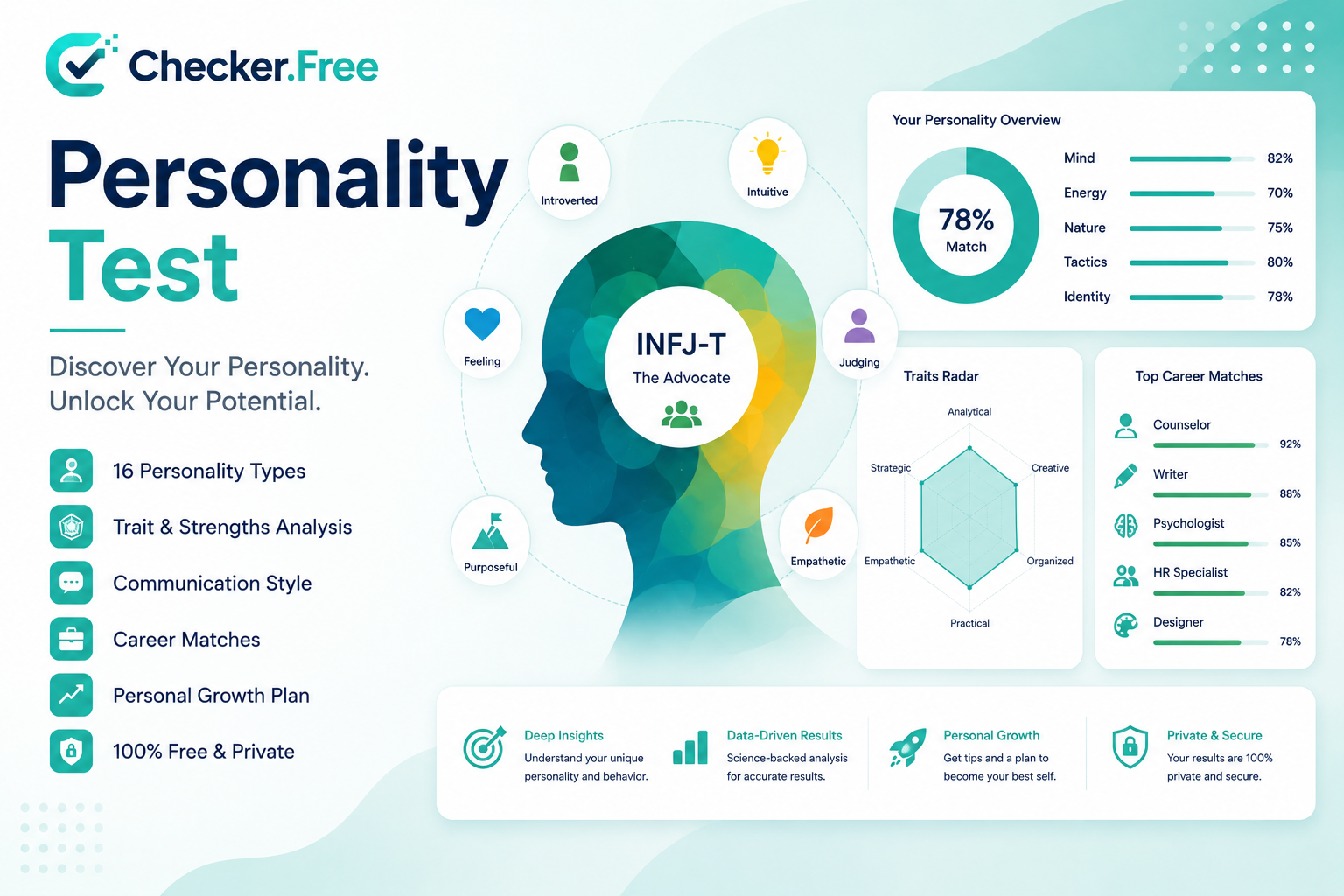
The page presents the experience as a Personality Check & Cognitive Profile Lab, with sections dedicated to personality assessment, the 16 personality types, compatibility exploration, and a career match atlas.
What Is a Personality Test?
A personality test is a structured self-report questionnaire designed to explore behavioral tendencies, cognitive preferences, communication patterns, and decision-making habits.
Unlike a medical examination, a personality assessment is not intended to diagnose a psychological condition. The Personality Check page explicitly describes its practical scope as self-discovery, communication, and personal development rather than psychological diagnosis.
This distinction is important.
A result such as INTJ or ENFP should be treated as a descriptive framework for reflection rather than a permanent definition of a person's identity.
Personality is complex, and the same person may behave differently depending on their environment, responsibilities, experience, culture, stress level, or goals.
How the Checker.Free Personality Test Works
The assessment contains 60 statements.
As you answer each statement, the interface updates the progress indicator and shows an emerging spectrum across four major dimensions. The page estimates approximately five minutes for completion and includes a question navigator for reviewing answered, unanswered, and bookmarked questions.
The four dimensions are:
Extraversion vs. Introversion
Sensing vs. Intuition
Thinking vs. Feeling
Judging vs. Perceiving
The assessment evaluates your responses directly in the browser and converts them into dimensional percentages, a 12-trait radar profile, career suggestions, and self-development recommendations.
Instead of waiting until the end to reveal everything, the interface also displays an Emerging Spectrum while the test is being completed.
The four live indicators are:
Introversion ↔ Extraversion
Sensing ↔ Intuition
Thinking ↔ Feeling
Judging ↔ Perceiving
The page notes that these signals normalize as more questions are answered.
The Four Personality Dimensions Explained
Extraversion vs. Introversion
This dimension concerns how a person tends to direct and replenish energy.
In the framework used by the page, Extraversion is associated with outward interaction and engagement, while Introversion emphasizes internal reflection and recovery.
Introversion should not automatically be interpreted as shyness.
A person can enjoy social situations, public speaking, or teamwork while still preferring substantial periods of internal processing and reflection.
The assessment therefore focuses on preference rather than judging one side as better.
Sensing vs. Intuition
This dimension concerns information processing.
Sensing emphasizes tangible details, observable facts, practical information, and concrete experience.
Intuition focuses more on patterns, possibilities, concepts, relationships between ideas, and future-oriented interpretations.
Someone with a Sensing preference may naturally ask:
What do we know?
Someone with a stronger Intuition preference may naturally ask:
What could this become?
Neither approach is universally superior. Different environments may reward different types of information processing.
Thinking vs. Feeling
This dimension describes different decision-making priorities.
Thinking emphasizes logic, objective analysis, structural relationships, and consistency.
Feeling gives greater weight to values, empathy, interpersonal consequences, and human harmony.
This does not mean that a Thinking-oriented person has no emotions or that a Feeling-oriented person cannot reason logically.
The framework is about preferred decision-making emphasis rather than the presence or absence of intelligence or emotion.
Judging vs. Perceiving
The fourth dimension concerns how a person approaches structure and daily execution.
Judging emphasizes planning, timelines, closure, organization, and defined decisions.
Perceiving places greater emphasis on flexibility, spontaneity, adaptation, exploration, and keeping options open.
A person may have a strong preference for planning in professional life while remaining spontaneous in social situations.
The assessment uses these dimensions as tendencies rather than rigid behavioral rules.
The page defines the four dichotomies around energy orientation, information processing, decision architecture, and lifestyle execution.
The 16 Personality Types
The four dimensions combine to create 16 personality archetypes.
The tool organizes them into four broader groups:
Analysts
The Analyst group contains the INTJ, INTP, ENTJ, and ENTP profiles.
The page describes this group as strategic, rational, and systems-focused.
INTJ — The Architect
Strategic and long-range oriented, with an emphasis on logical systems, efficiency, and planning.
INTP — The Logician
Conceptual and analytical, with an interest in theories, models, and precise reasoning.
ENTJ — The Commander
Organized and decisive, with an emphasis on coordinating resources and implementing large goals.
ENTP — The Visionary
Innovative and exploratory, often interested in new connections and challenging conventional assumptions.
Diplomats
The Diplomat group contains INFJ, INFP, ENFJ, and ENFP.
The page describes these profiles as empathetic, values-driven, and growth-oriented.
INFJ — The Advocate
Focused on purpose, human potential, principles, and long-term meaning.
INFP — The Mediator
Associated with authenticity, personal values, creativity, and compassion.
ENFJ — The Protagonist
A socially oriented profile emphasizing mentorship and collective development.
ENFP — The Campaigner
Curious, energetic, creative, and oriented toward possibilities.
Sentinels
The Sentinel group contains ISTJ, ISFJ, ESTJ, and ESFJ.
These profiles are presented as methodical, dependable, and process-grounded.
ISTJ — The Inspector
Associated with factual accuracy, procedural consistency, and reliability.
ISFJ — The Protector
Focused on stability, support, responsibility, and dependable follow-through.
ESTJ — The Executive
Organized around standards, coordination, logistics, and execution.
ESFJ — The Consul
Community-oriented, cooperative, and focused on social harmony.
Explorers
The Explorer group contains ISTP, ISFP, ESTP, and ESFP.
The page describes these profiles as practical, adaptable, and responsive.
ISTP — The Virtuoso
A pragmatic problem-solver interested in mechanics, tools, and hands-on analysis.
ISFP — The Adventurer
Associated with personal authenticity, sensory awareness, freedom, and visual expression.
ESTP — The Dynamo
Action-oriented and responsive to real-time challenges.
ESFP — The Entertainer
Spontaneous, experiential, energetic, and socially expressive.
The page makes all 16 archetypes available through a dedicated 16 Personality Types section.
Personality Types vs. Personality Traits
One important distinction is the difference between types and traits.
A type model organizes tendencies into broader archetypes.
A trait model instead measures characteristics along continuous scales.
The page specifically contrasts its type-based framework with trait models such as the Big Five / OCEAN approach.
This is why a personality result should not be interpreted as:
“You are exactly this kind of person.”
A more useful interpretation is:
“Your responses show stronger tendencies toward this particular pattern.”
Traits can exist in degrees, and people may show different behaviors depending on context.
The 12-Trait Radar
After completing the assessment, the tool generates a Response-Based Trait Radar & Explorer.
The page describes this section as quantifying 12 secondary behavioral traits directly from the answers. A radar chart provides a visual representation, while a separate list displays the corresponding trait levels.
The radar is useful because two people can receive the same broad type while still showing different secondary behavioral patterns.
For example, two people may both receive the same four-letter profile but differ in how strongly certain related traits appear in their results.
That provides more nuance than looking only at the four-letter code.
Why You Received Your Personality Result
The results dashboard includes a dedicated Why You Received This Result section.
Instead of showing only the final type, the report explains the response signals associated with that result and presents the closest personality matches.
This can make the report easier to interpret because users can connect the final profile to the answers they provided.
A useful approach is to read this section critically:
Which observations feel familiar?
Which ones feel less accurate?
Are some behaviors strongly dependent on your work environment?
Did you answer based on your usual behavior or your ideal behavior?
A personality report becomes more valuable when used as a starting point for reflection instead of something that must always be accepted literally.
How to Get Better Personality Test Results
The quality of a self-report test depends heavily on how honestly and consistently you answer.
Checker.Free recommends responding based on your natural, regular habits rather than aspirational ideals. It also warns that overthinking individual prompts or answering according to temporary mood swings can distort the dimensional balance.
A better testing approach is:
Think about your usual behavior
Ask what you normally do, not what you think you should do.
Avoid trying to get a specific type
Choosing answers because you want to become an ENTJ, INFJ, or another profile can reduce the usefulness of the result.
Consider patterns over time
Think about how you typically behave across weeks and months rather than focusing on what happened yesterday.
Answer independently
Do not select an answer simply because another person expects it from you.
Personality Test and Career Matches
One of the main features of the results dashboard is Personalized Career Matches.
The page can organize career suggestions into categories including:
Technology
Business
Creative
The career area is explicitly described as matching careers according to calculated congruence with cognitive dimensions and traits.
A separate Career Match Atlas allows users to explore professions across:
Profession
Field
Target Personality
Key Strength Needed
Work Environment
These suggestions should be treated as exploration tools rather than definitive career recommendations.
Your interests, education, technical abilities, experience, financial priorities, location, opportunities, and personal goals also matter.
Personality is one possible input among many.
Personality and Workplace Communication
Personality frameworks can also be useful for understanding communication preferences.
For example, some collaborators may prefer:
Short summaries
Clear action items
Structured documentation
Detailed discussion
Brainstorming sessions
Time to reflect before responding
The page includes communication as part of its broader interpretation of personality and team interaction.
Understanding differences in communication style can sometimes help teams reduce unnecessary misunderstandings.
However, personality type should not become a justification for poor communication.
Regardless of type, effective collaboration still depends on listening, clarity, respect, and willingness to adapt.
Personality Compatibility Explorer
The Dual-Type Compatibility Explorer allows users to select two personality types and examine their interaction.
The tool is designed to calculate:
Synergy
Communication dynamics
Potential friction points
The interface allows the user to select a first type and second type and then generate the corresponding compatibility report.
This is useful for educational exploration, but personality compatibility should never be treated as a prediction of whether two people will succeed in a friendship, relationship, or professional partnership.
The page itself emphasizes that relationships depend on emotional maturity, active listening, shared values, and mutual communication rather than simply having compatible four-letter codes.
Personality Tests and Relationships
A personality profile can provide language for discussing differences.
For example, partners may use personality concepts to discuss:
Communication preferences
How they process conflict
How they make decisions
How much structure they prefer
How they approach social activities
How they handle personal space
But personality should not be used to excuse unhealthy behavior.
A statement such as “That is just my personality type” should not replace accountability or communication.
The strongest use of a personality assessment is often to generate questions for discussion rather than provide absolute answers.
The 7-Day Cognitive Expansion Challenge
The results report contains a 7-Day Cognitive Expansion Challenge.
The purpose is described as providing actionable daily micro-exercises designed to develop less-dominant cognitive tendencies.
This turns the assessment from a static personality label into a potential self-development exercise.
Instead of only asking:
What is my personality type?
the tool encourages a second question:
What behaviors could I deliberately practice?
This can be a more productive way to use personality frameworks.
Is This an Official MBTI Test?
No.
This distinction is especially important.
The page explicitly states that MBTI® is a registered trademark of The Myers-Briggs Company and that Checker.Free provides an independent self-assessment inspired by classical Jungian typology and dimensional scoring. It is not officially affiliated with MBTI®.
Therefore, the Checker.Free assessment should be understood as an independent personality exploration tool rather than an official Myers-Briggs assessment.
Are Online Personality Tests Accurate?
A personality test is not a laboratory measurement of someone's complete identity.
The page describes online assessments as useful frameworks for self-reflection, communication, and workplace preferences, while explicitly noting that they are not clinical diagnostic instruments.
Several factors can influence the result:
How honestly you answer
How well you understand the questions
Your current circumstances
Your interpretation of your own behavior
The specific scoring model used
How strongly your preferences sit near the middle of a dimension
For that reason, it is often more useful to focus on the descriptions and patterns that resonate with your experience than to become overly attached to a four-letter label.
Can Personality Preferences Change?
The page notes that general behavioral tendencies can remain relatively stable while personality expression continues to evolve through life experience, career roles, intentional practice, and maturity.
This means a personality test taken at one stage of life does not necessarily have to produce exactly the same emphasis forever.
Your environment can influence how you express your preferences.
A student, manager, entrepreneur, parent, engineer, designer, or salesperson may all develop different behavioral strategies even if their underlying preferences remain relatively similar.
This is another reason to treat personality assessments as snapshots and reflection tools.
Privacy and Local Processing
Privacy is particularly relevant for personality tests because assessment responses can feel personal.
The Personality Check page states that calculations, responses, and saved results are processed locally in browser memory and localStorage, with no personal test data sent to external servers.
The page's dedicated privacy section likewise describes the assessment as 100% client-side processing and states that dimensional percentages and trait levels are calculated directly from the selected answers.
This local-processing model is relevant for people who prefer to keep their assessment responses within their own browser environment.
The interface also provides a history area for past assessments and can save an unfinished session so that it can be resumed later.
A Practical Way to Use Your Results
After completing the test, avoid focusing only on the final four letters.
A more useful workflow is:
1. Read the main type description
Understand the broad pattern.
2. Review the four dimensions
Look at which side of each dichotomy is more strongly represented.
3. Study the trait radar
Identify secondary characteristics that add nuance.
4. Read the strengths and growth sections
Look for both useful tendencies and possible blind spots.
5. Examine career matches
Use them to generate ideas rather than restrict your choices.
6. Review the relationship profile
Consider how your communication and interaction style may affect other people.
7. Complete the seven-day challenge
Use the result as a starting point for experimentation and personal growth.
Personality Test, Keyboard, Mouse and Other Checker.Free Tools
Personality analysis is one part of the broader Checker.Free collection.
For technology and productivity testing, you can also explore:
Keyboard Checker — inspect keyboard input and individual keys.
Mouse Checker — test mouse buttons, scrolling and pointer behavior.
CPS Checker — measure clicks per second.
Mic Checker — inspect microphone input and audio behavior.
Password Strength Checker — analyze password strength and security characteristics.
Diff Checker — compare text and identify differences.
The Personality Check page itself includes several of these tools within its navigation, including Keyboard Checker, Mouse Checker, CPS Checker, Mic Checker, and Password Strength.
Final Thoughts
A personality test is most useful when it creates better questions about yourself rather than pretending to provide a permanent definition of who you are.
The Checker.Free Personality Test combines a 60-question assessment with four core cognitive dimensions, 16 personality archetypes, a 12-trait radar, personalized strengths, growth opportunities, career exploration, relationship insights, compatibility analysis, and a seven-day development challenge.
Its four-dimensional structure provides a simple way to explore preferences across:
Energy → Information → Decision-Making → Lifestyle
The 16 archetypes then provide a broader narrative around those dimensions, while the trait radar adds additional detail.
The most important limitation is also clearly stated by the page: this is an independent self-reflection assessment, not an official MBTI® instrument or a clinical psychological diagnosis.
Used appropriately, however, a personality assessment can provide a useful vocabulary for thinking about communication, work habits, relationships, personal strengths, and areas where you might deliberately develop new skills.
The best result is not necessarily a particular four-letter code. The real value comes from using the profile as a starting point for self-observation, discussion, and intentional growth.
Take the full assessment at Checker.Free Personality Check & Cognitive Profile Lab.
Comments
Post a Comment